Where to Find Authentic Visa Rules for Your Next Trip
A checklist for Indian travellers: where to find authentic visa and entry rules, and the order we would check them in.


Entry rules change often, and the internet is full of outdated blog posts, look-alike "official" websites and well-meaning WhatsApp forwards. We have put together the places we would check ourselves, in the order we would check them.
You don't need all of them for every trip. But for any trip where you aren't 100% sure, going through this list takes about twenty minutes and can save you a ruined holiday.
1. Start with the destination's own government
The country you are visiting decides who gets in. So the most reliable answer always comes from that country's immigration authority, its official e-visa portal, or its embassy or consulate in India.
How to spot an official site
Government websites usually sit on a government domain:
| Country | Typical official domain |
|---|---|
| India | .gov.in |
| Thailand | .go.th |
| Sri Lanka | .gov.lk |
| Singapore | .gov.sg |
| UAE | .gov.ae |
| Malaysia | .gov.my |
| Vietnam | .gov.vn |
| Indonesia | .go.id |
| Japan | .go.jp |
A few examples we confirmed on the official pages:
- Sri Lanka: the ETA is applied for at eta.gov.lk. When we checked on 5 October 2026, the page said the tourist ETA is free for Indian nationals under a scheme effective 25 May 2026, valid for 30 days with double entry. Fees can change, so check the page on the day you apply.
- Singapore: the SG Arrival Card is a free health declaration, to be submitted within three days (including the day of arrival) before you arrive. Singapore's immigration authority (ICA) says it does not endorse commercial services that charge a fee to submit it for you.
- UAE: the Federal Authority for Identity, Citizenship, Customs and Port Security names icp.gov.ae as its official domain, and warns about fake phone calls and counterfeit websites.
- Malaysia: the MDAC is a digital arrival card on a
imi.gov.mydomain. It also reminds visitors that more than USD 10,000 equivalent in cash must be declared. - Thailand: the e-visa site is thaievisa.go.th. Separately, everyone entering must complete the Thailand Digital Arrival Card at tdac.immigration.go.th, which asks for your details 3 days before you arrive.
- Vietnam: the e-visa is applied for at evisa.gov.vn. The page says it is valid for up to 90 days, with a fee of USD 25 for single entry or USD 50 for multiple entry, and that the fee is not refunded if the visa is refused.
Red flags that a site or "agent" is not official
- It copies a government homepage but uses a different domain.
- It charges a service fee for a form that the government offers for free.
- It reaches you first, by phone, WhatsApp or social media, claiming to be an embassy or immigration office.
- It asks you to pay by an unusual method or to send documents over chat.
2. Cross-check with the IATA Travel Centre
Airlines check your documents against a rules database run by IATA, the airline industry body. A free version is open to everyone at the IATA Travel Centre.
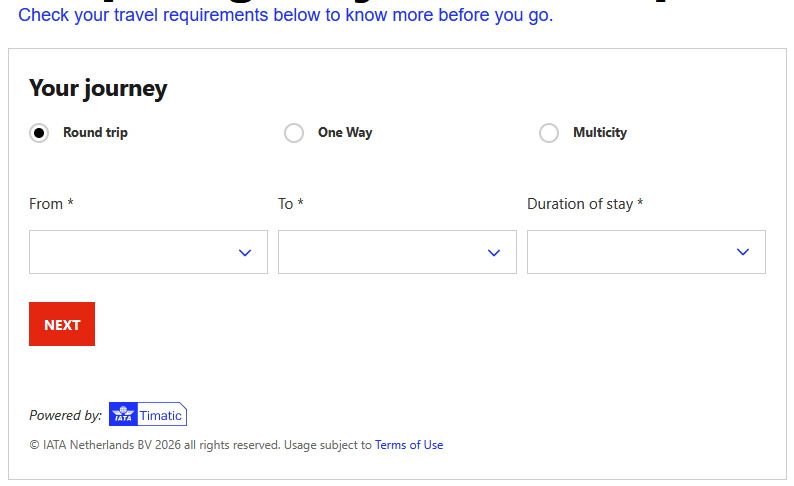
Pick India as your nationality, then add where you are flying from, any transit stops and your destination to see passport, visa and health requirements.
Treat it as a second opinion, not the final word. IATA is not a government, correct documents don't guarantee entry, and airlines may add rules of their own. If it disagrees with the destination government's portal, go with the government and ask your airline.
3. Check your airline's travel-requirements page
Your airline is the one that decides whether you board. Most major airlines have a "travel requirements" or "travel documents" page, and some have a live chat for it. Check:
- your destination;
- every transit country, because transits can need their own visa or have their own rules;
- anything the airline asks for that the government doesn't, such as proof of onward travel.
4. Do the Passport Validity Check
Most countries want your passport to be valid for at least six months beyond your arrival date, and with enough blank pages. Check the destination's own rule, since a few differ.
5. A pre-trip checklist
- ☐ Passport valid for the destination's required period, with blank pages
- ☐ Visa, e-visa or ETA approved before you travel (not "on its way")
- ☐ Transit countries checked too
- ☐ Arrival cards or health declarations done, on official sites only (many are free)
- ☐ Travel insurance, hotel confirmations and onward ticket handy, in print and on your phone
- ☐ Any customs or cash-declaration limits looked up
- ☐ Rules re-checked a few days before departure
- ☐ Screenshots of the official pages, with the date visible, saved on your phone
What if something doesn't add up?
If two sources disagree, trust the destination government's own page, then ask your airline in writing, and keep the reply. If you are still unsure, ask someone who handles this every day.
We can help
This is the part we handle. When we plan a trip with you, we check the entry requirements for your passport and every stop on the route, and we stay with you if plans change before you take off or while you are traveling.
We handle the details. You create the memories.
Last checked: 5 October 2026. Entry rules change often, so use this post as a guide to where to look, and always confirm on the official source before you travel.