

Stop Searching for Prices. Search for Dates Instead.
Airfare isn't expensive. Your dates are. Here's how to find cheaper dates with ITA Matrix.


Most people book flights backwards.
They decide the dates first, search once, stare at the fare, and make an emotional decision: either book through the pain or assume flights are just expensive right now.
That feels rational, but actually isn’t. Flights don’t have fixed prices. Dates do.
A Delhi to Paris trip might be ₹38,000 on Tuesday, ₹72,000 on Saturday, and ₹49,000 if you stay 9 nights instead of 7.
Same destination. Same month. Completely different economics.
The mistake is asking the wrong question.
Wrong: What does my trip cost?
Right: Which dates is this route willing to discount?
That shift changes everything.
Why ITA Matrix
Google Flights is excellent if you already know your dates. But that’s the catch.
It assumes you’ve already made the biggest pricing decision.
ITA Matrix, the airfare engine behind much of modern flight search, lets you inspect the pricing landscape before committing.
It’s uglier. You can’t book directly. But it exposes the logic.
How to do this in 90 seconds
Instead of searching: Delhi → Tokyo | Oct 12–20
Search: Delhi → Tokyo | Flexible dates | 7–10 nights | Calendar view
Instead of one quote, you see a pricing map.
Patterns become obvious:
- cheaper departure clusters
- weekend spikes
- midweek dips
Suddenly your “expensive Europe trip” was just an expensive date choice.
Step 1: Enter the route, not fixed dates
If you have flexibility, search cities instead of specific airports.
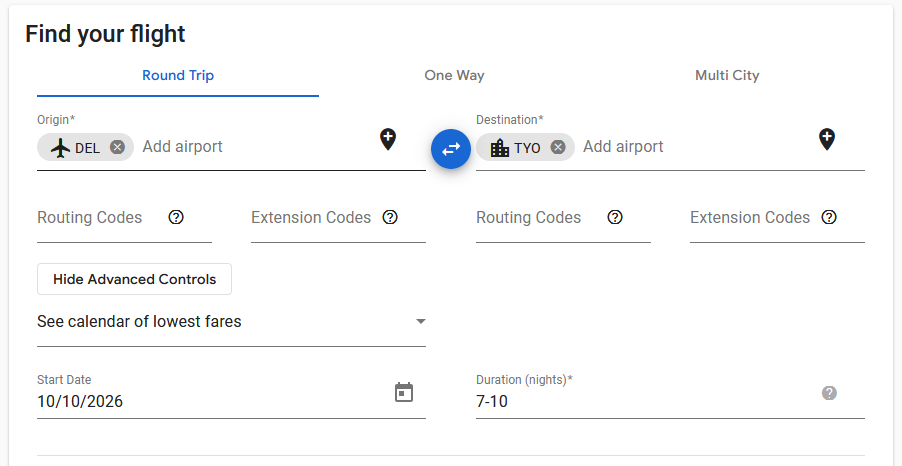
Examples:
- London instead of Heathrow (Covers Gatwick, Stansted and LHR)
- Tokyo instead of Narita (covers Narita and Haneda both)
Don’t lock yourself into exactly 7 nights. Try: 7–10 nights
Wider search space = better odds.
Step 2: Switch to calendar view
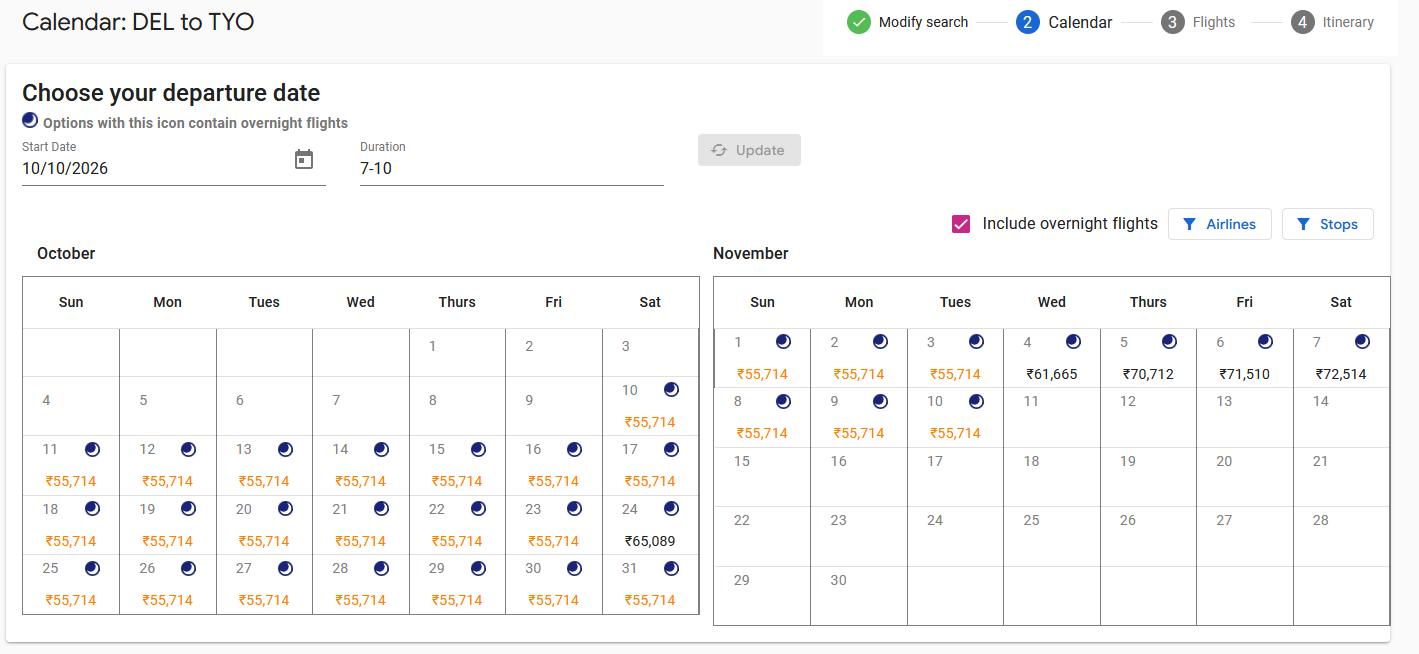
This is the key screen. Instead of a single fare, you see the price surface across multiple dates.
Step 3: Shortlist, then inspect
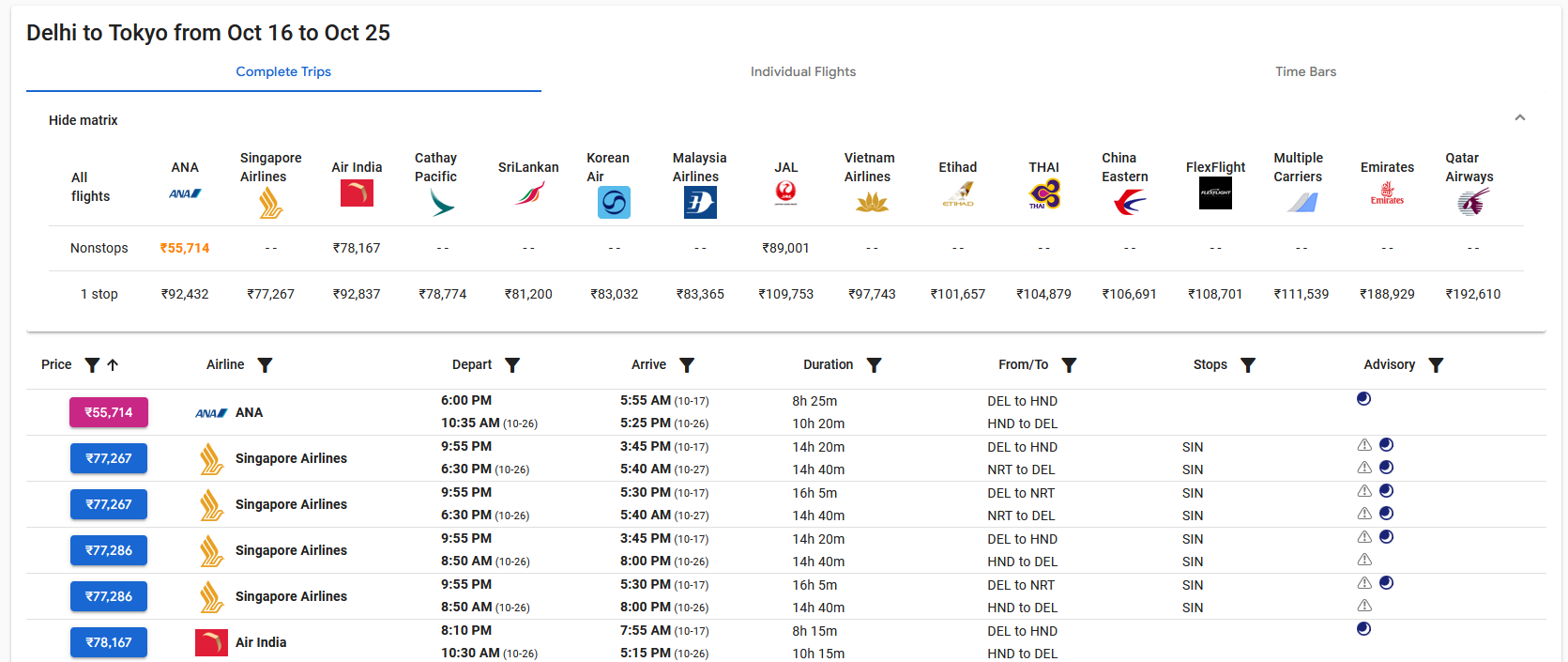
Don’t blindly click the cheapest fare. A ₹4,000 saving is not worth a 19-hour airport layover.
So essentially do two passes:
Pass 1 — Find cheap windows. Pure reconnaissance. You're looking for pricing clusters and obvious outliers. Not itinerary perfection.
Pass 2 — Sanity check the routing. Once you've identified attractive windows, inspect the actual flight. The goal isn't the absolute cheapest fare. The goal is high value.
Where this works best
This technique works best where demand swings sharply.
Best: Europe, USA, Japan, Australia, New zealand – Long-Haul Flights
Less successful: Southeast Asia, Short-haul flights like Srilanka, Dubai
Long-haul + flexible dates is where this shines.
When this doesn’t help
If your dates are fixed, this matters less. Examples - weddings, school schedules, visa deadlines, emergency travel
Then you’re optimizing execution, not timing.
The honest version
ITA Matrix isn’t magic. It’s ugly.
Fares can disappear fast. The interface is clunky. For simple trips, Google Flights is often enough.
This isn’t about replacing simpler tools. It’s about changing one question.
Before searching your dates, find out which dates the airline actually wants to sell.
Bonus: For the travel nerds only
Once you get comfortable with the basics, ITA Matrix gets much more powerful.
A few rabbit holes (click on Advanced Controls)
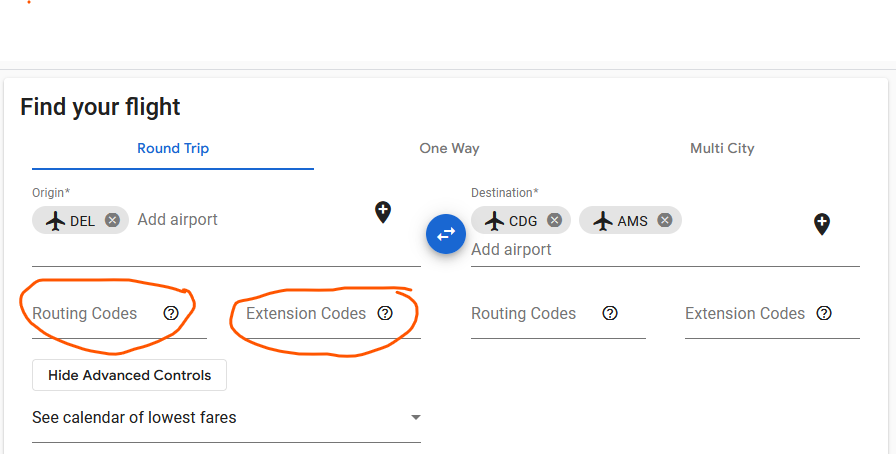
Routing controls
Avoid flying through middle-east hubs:
~x:DXB,AUH,DOH,BAH,MCT,KWI,AMM,RUH,JED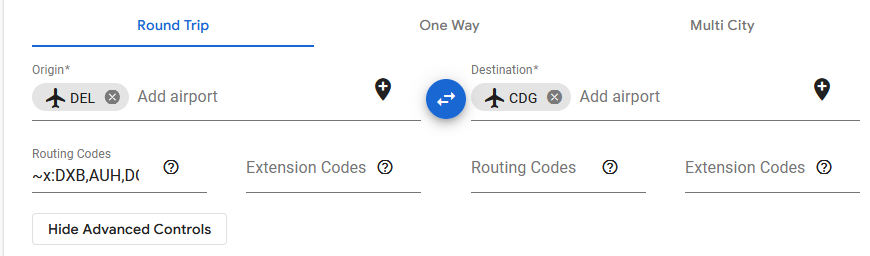
Require a specific hub connection
x:HELForce nonstop, but only on specific carriers
C:AI,LHFinding Open-jaw Fares (sometimes cheaper)
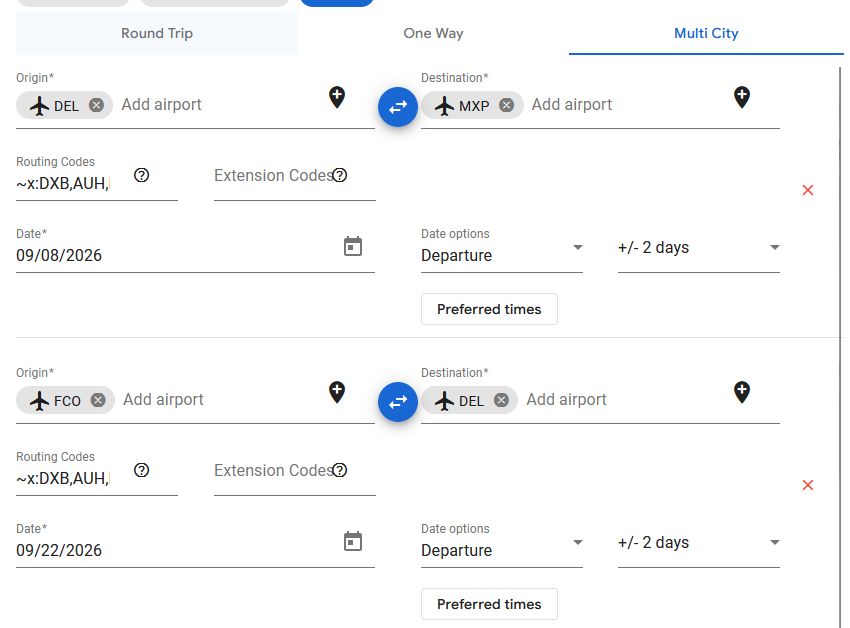
Fly into Milan (MXP), travel north, fly home from Rome (FCO). Search: DEL-MXP / FCO-DEL using multi-city search. Matrix prices this as a single round-trip fare construction rather than two one-ways, which is almost always cheaper.
Warning: this is how people accidentally become the designated “flight booking friend.